Pages

Thursday, January 21, 2016

How the raven became a gentleman: the evolution of the fable of the fox and the raven in book illustrations


Gustave Doré in: De Fabelen van La Fontaine, 1895


J. Punt in: Fabelen van J. De la Fontaine, 1805
Practically everybody knows the story of the tortoise and the hare. The overconfident hare that decides to take a nap in the middle of a running contest, while the slow but modest tortoise follows through and finally wins the competition. A story that teaches us that slow but certain is better than fast and improvident and that teaches us morals about how to behave well in society.
These fables find their roots in the sixth-century before Christ. It is thought that they were written by the Greek slave Aesop. Although his existence remains uncertain and none of his writings survived, numerous tales credited to him, were gathered across the centuries. Many of the tales are characterized by animals and lifeless objects that speak, solve problems, and have human characteristics.

The representation of fables in pictures has a long history as well. In comparison to other illustrative fashions the fable was a conservative one, which makes the development of the fable illustration a very interesting subject. From the fifteenth to the nineteenth century there has been little to none evolution in the way the fables were depicted. To demonstrate this, one can compare different illustrations of the fable ‘the fox and the raven’. In this fable a raven (or sometimes a crow) has found a piece of cheese and decides to eat it on a branch. The fox, who wants it for itself, flatters the bird, calling it beautiful and wondering whether its voice is too. While it starts singing, the cheese falls out of his beak and is eaten by the fox.


J. Gole in: Sinryke Fabulen, 1685
The scene is originally portrayed in the same way over and over again as seen in the small selection of the work by J. Gole, J. Van Vianen and J. Punt. This goes on until the French illustrator and caricaturist J. J. Grandville (1803-1847) gets his hands on the story. Instead of disguising the moral of the story in animal figures, he gives the animals back their human characteristics and places the scene in the spirit of his age. The raven becomes an elite gentleman with his glasses and honorary medal, while the fox is depicted as a mischievous fellow of the lower class.
J. van Vianen in: Ezopische fabelen van Fedrus, 1703


Another innovator of the fable illustration was the French illustrator and painter Gustave Doré (1832-1883). Doré perfectly represented the romantic ideas of his time in his illustrations. 
He did this by depicting the events of the fable in the corner and filling the predominant part of the plate with dark forests and wild cloudscapes, although his picture of the fox and the raven is more conservative than innovative.


J. J. Grandville in: Fables de La Fontaine, 1852
De Rave om hoog op eenen boom gezeten
Zou een stuk kaes, dat zy gerooft had, eten.
Dit zag de Vos, en sprak aldus haer aen:
Wat zytge, o Raef, met schoonheit aangedaen!
Hoe schoon is uw gelaet! hoe schoon uw veren!
Hoe zeer zoud gy elk een betrionferen,

Indien ’t geluk, dat alles overheert,
U midelyk had met een’ stem vereert,
Waer van gy ongelukkig blyft versteken!
De domme Raef begint hier op te spreken.
Maer zy verliest terstond naer lekker aes.
De looze Vos schiet toe, gaet met de kaes.

Voort stryken, en belacht dees grove botheit.
De Rave ziende in ’t einde hare zotheit,
Sprak dus: Ik leer met schade dezen dag,
Dat wysheit meer dan sterkte en kracht vermag.

Ezopische fabelen van Fedrus, 1703, 21-22 pp.


[left] (Probably) J. van Noord, 1791
[right] J. Desandré and W. H. Freeman in: Fables de J. de la Fontaine, 1868

by Sanne Hansler


Wednesday, January 13, 2016

Steven Blankaart's ‘De borgerlyke tafel, om lang gesond sonder ziekten te leven’


With the New Year come new resolutions. What more popular than the wish to eat healthier in the next year, or at least until we feel better about ourselves or swimwear worthy.

So how do you go about eating healthier? First of all you should know what to eat and what not of course. These days it is all about the super foods, raw food, no carbs, no fat (or is fat good now?) and so on. Every year seems to have a new trend in what is healthy and what not. 


Apparently hundreds of years ago people suffered from the same ideas as we do now. In fact it is the other way around: we still have this obsession with health trends, and have had this for a long time. In 1683 a book was published in Amsterdam called ‘De borgerlyke tafel, om lang gesond sonder ziekten te leven’ (The civil table, to live a long healthy life without illness). 

The title is so refreshing: it says exactly what the purpose of the book is! So this book is a kind of cookbook with the latest healthy food tips, just like there are so many today. Actually the title of the book is more elaborate, it goes on as follows: ‘Waar in van yder spijse in ‘t besonder gehandelt werd. Mitsgaders een beknopte manier van de spijsen voor te snijden, en een onderrechting der schikkelijke wijsen, die men aan de tafel moet houden.' (In which every ingredient is treated separately. Furthermore with a concise manual of the cutting of the dishes, and an education in table manners). So the author Steven Blankaart, a physician of profession, had huge goals in mind with this book. The frontispiece (engraved title print) shows that he had a very broad audience in mind as well. At the table young, adult and old all eat the healthy food that Blankaart prescribes in this book. 

[Reference Nr. B1467]


by Hugo Rijpma 


Friday, January 8, 2016

Theodor de Bry (1528-1598) ORGUEILLE ET FOLLIE

Portrait of Pope Paulus IV(?)
Published c. 1580 this plate, Pride and Folly, belongs to a series of four designs for tazzas by de Bry. It is a medallion with a double head: if turned around the print shows a profile of a satyr, reminding of Folly. The border is decorated with fantastic creatures, themes and symbols referring to Superbia like a peacock, the mistress of Babylon, the fall of Phaeton, the Fall of Marcus Curtius, Adam and Eve under the tree. The other four plates of the set feature the same characteristics: a medallion included in a wide border with grotesques with figures, animals and vines on a dark ground. The border around the medallion and the outer edge feature Dutch and French verses.

It has been suggested that the male profile might be that of Pope Paul IV (born Gian Pietro Carafa, 1476-1559) who instituted the Inquisition as a political organ of the Church, to control not only dogmatic issues but also political and economical businesses. Under his papacy was introduced the 'Index librorum prohibitorum' and 'ghettos' for the Jews were institutionalized with the 'Cum nimis absurdum' bull (1555). This bull revoked all the rights of the Jewish community and placed religious and economic restrictions on Jews in the Papal States, renewed anti-Jewish legislation and subjected Jews to various degradations and heavy restrictions on their personal freedom.

Signed within internal border: 'T. D. B. F.'. On the verso unknown collector's mark.
The Satyr

The Mistress of Babylon
Engraving on paper, trimmed within platemark; diameter: 124 mm; only state; some dirt and traces of former mounting on the verso, irregular margins; Hollstein 180; Guilmard 368; Atlas van Stolk I, 413. Exhib 1987, Ornemanistes du XVe au XVIIe siècle, no. 68.

Reference nr. 60535


by Anna Bianco

Thursday, January 7, 2016

Louise Charlotte Ritter (1779-1859): Self portrait as personification of Pictura

Beautiful drawing by Louise Charlotte Ritter (1779-1859). She portrayed herself as a personification of Pictura, sitting beside a table with a skull, the bust of Homer, a sculpture and a drawing; she is holding a palette and brushes, she's gazing at a painting on an easel. She is sitting in an ideal classical looking interior with a colonnade ending behind her and decorated with a green curtain . The painter is dressed in antique fashion in a white dress with a fallen shoulder pad, uncovering partially her breasts. A darker robe probably covering her shoulder has also fallen; only a small portion hangs from her right shoulder. Her skin is very pale, reminding the texture of a sculpture; almost like a goddess she wears sandals, a hairband and a golden armband, around her forearm. Signed on the bottom right: 'L: C: de Neufville née Ritter inv: t et pinx:t.'

Drawing on paper; pen and brush in grey, brush in color, framing line in pen brown ink; total: 128 x 99 mm
[reference nr. 60563]

Thursday, November 19, 2015

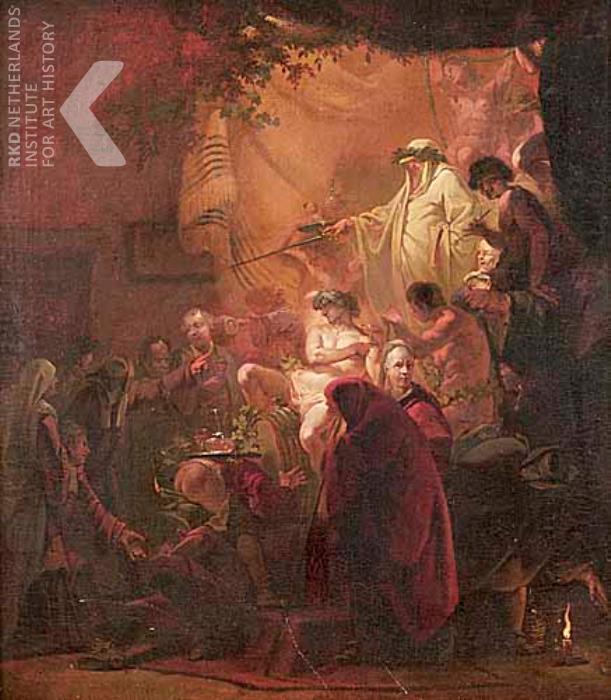
Initiation of a member of the Bentveughels (the Schildersbent)

Initiation of a member of the Bentveughels (the Schildersbent)
The original painting (RKDimages)
Print after a painting by Domenicus van Wijnen (1661-1698) (private collection), reduced in measures and mirrored in respect to the first copy by Matthijs Pool (1676-1740). According to Johan van Gool, Bonaventura van Overbeeck entrusted Pool with the engraving after a set of three paintings by van Wijnen, to ensure the immortality of the brotherhood and to please the lovers of the art of print. According to Tania De Nile (I Bassifondi del Barocco: La Roma del vizio e della miseria, exhib. cat., 2014, p. 164-165) this explains the precision with which faces of the participants and the features of the staged spectacle are reproduced. The present print reproduces the first painting of the series: a sort of 'tableau vivant' taking place in an inn, where the bentbrothers are dressed in antique attire, each of them playing a different role in the curious staged mythological pantomime preceding the initiation ceremony. The 'Veltpaap' (countryside priest) stands on the top left of the composition, crowned with laurel, pointing with his long sword in the direction of the newcomer, or 'Nieuwling' or 'Groentje' (literally 'the green youngster') introduced by a pander and another character holding a long halberd (the 'Switzer', or the Swiss). 
On the bottom two columns of text in Dutch: 'De Roomsche Achilderbent, de Waareld door vermaart... Wort hy verwellekomt, met eerchooten aan den dis'; on the bottom address of Pool:'M. Pool exc: Amstelod: op de Leydse Graft by de Heeren Graft'.
Soon after the master of ceremonies had pronounced a series of precepts concerning the art of painting and the sacred statute of the company, the young artist would have sworn his loyalty in front of the other brothers. These would have replied with: 'Viva, viva, viva onzen nieuwe Medebroer!'. Bacchus would have been present to the ceremony, seated on a barrel, as he was the protector of the brotherhood. Below on the right one brother is lighting a firecracker which refer to one of the tests the newcomers had to take to enter the brotherhood. (De Nile).


Wednesday, November 18, 2015

From the Sistine Chapel in Rome...

Niccoló della Casa after Michelangelo (Nr. 60423)
For the upcoming Jubilee 2015 here is a bit of Michelangelo's Last Judgement: Seventh of the twelve plates engraved by Nicoló della Casa after 'The Last Judgement' by Michelangelo: angels blowing their trumpets announcing the Judgement while two in the front, holding books are choosing the destiny of souls. Group just below the Judging Christ. For a view of the complete series see Metropolitan Museum of New York, inv. 62.602.652(1).
When the 'Last Judgement' by Michelangelo was uncovered in 1541 not everyone was allowed to see such painted wonder. Print dealers and publishers felt that perhaps print buyers that could not see the original might have welcomed printed copies. As Anne Dillon puts it '[print buyers] would have heard of [the fresco], talked about and would be keen to have as close a depiction of it as possible. The printers did not disappoint. They ensured that their engravers fulfilled these commercial demands and followed the original as closely as possible. This was the approach adopted by Nicoló della Casa when he engraved Michelangelo's Last Judgement in eleven [sic!] plates.' (A. Dillon: Michelandelo and the English Martyrs, 2012, p.150). All the plates of the set have irregular shapes, however this impression has been deeply cut within the platemark until the bell of one of the trumpets.
Bury (Michael Bury, Niccolò Della Casa’s Last Judgement Dissected, Print Quaterly, XXVII, 2010, 1, pg.3-4) maintains that besides the plate with 'Caron's ship' and other three, the present plate, 'Judging Jesus' and 'The Resurrection of Death' were printed to be sold as sigle sheets. Bernadine Barne shares this same opinion (Bernadine Barne, Michelangelo in print, 2010, pg. 106) confirmed by the presence on the print of the inscription recalling that Michelangelo painted the fresco, the source of this print. The inscription disappears when set up with the other plates.
Lettered below on the right:'MICHEL ANGELVS FLORENTINVS PINXIT IN VATICANO / EXCVDEBAT ANT. SALAMANCA 1548' more at http://www.antiquariaatvandersteur.nl/Webwinkel-Product-131297423/The-Last-Judgement.html

Saturday, October 31, 2015

Halloween is here!


Today is ‪Halloween‬, so we treat you with these beautiful books about ‪Ghosts‬! For sale at www.vandersteur.nl, EUR 736.

It's meant for "Allen, welken het bestrijden en afleggen van ontrustende vooroordeelen, met opzicht tot het aanwezen van geesten ernst is.....'.
Here is a list of some of the remarkable ghost stories in this book:
1. Van een spook, hetwelk eene deur, die niet alleen gesloten, maar ook van binnen gegrendeld was, van buiten opende, en eenen openbaaren lochenaar van spooken verbaasd.'
2. Bewys, dat een mensch zig in de daad zomwylen op twee plaatzen teven kan laten zien.
3. Van een brommend spook, hetwelk eens eene andere spookgedaante op het middagtsuur eenen vreeselijken schrik aanjoeg.
4. Van eenige honderd spooken, die in eene kerk, in West Pruisen, hunne zeer wonderlyke en nogthans natuurlijke rol speelden.
5. Van eene wezenlijk overledene matroone, welke, onmiddellyk na hare begraafnis weder levende in haar sterfbed lag.
6. Bewijs dat sommige mensen zich zelven dubbel zien.
8. Van een spook, het welk in eene oude ridderzaal, met veel geraas zyne spokerijen dreef, en veeltijds het licht uitblies.
15. Van een spook, het welk na dertien jaaren tusschen vier muren gemetsels te zijn geweest, nog zingende spookte.